
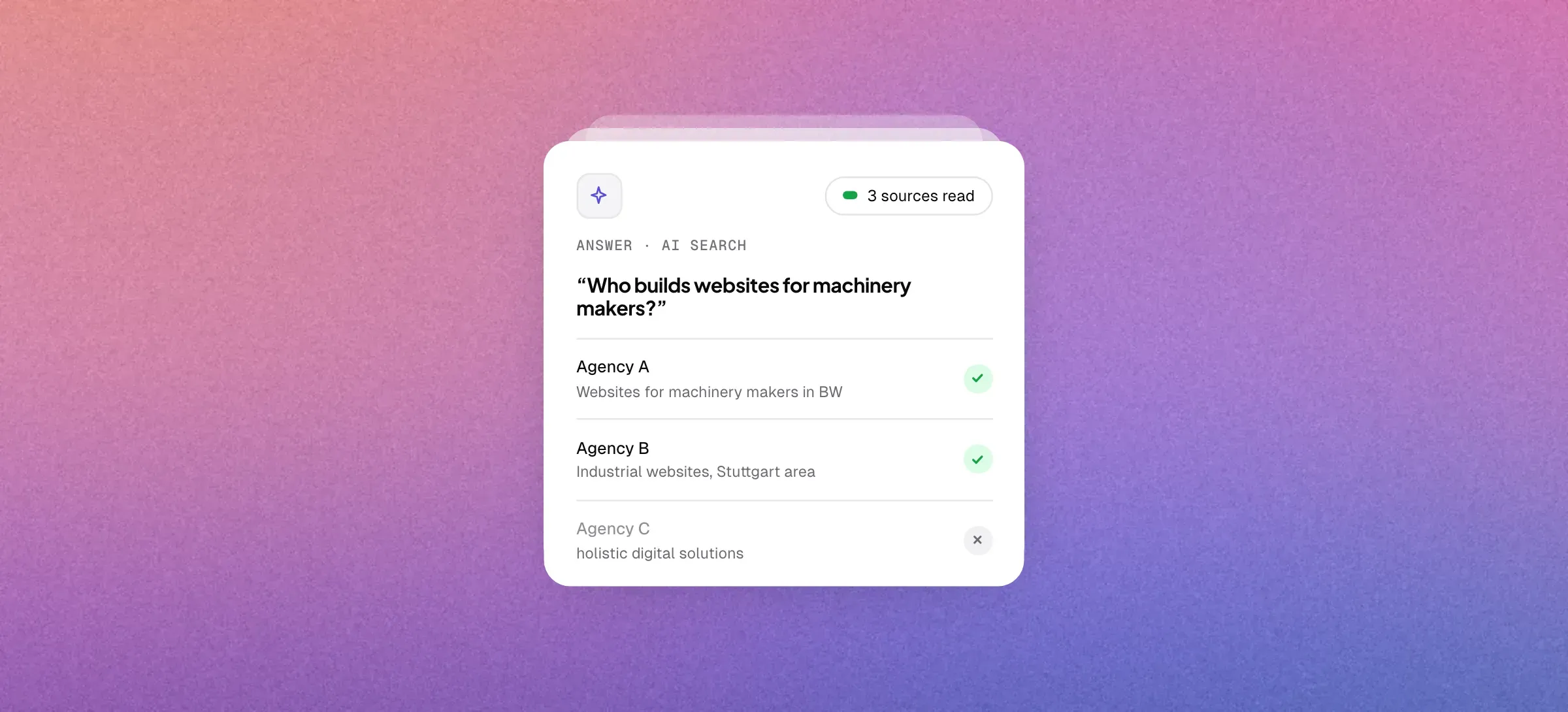
There is a question that has quietly turned into a different one over the last two years. It used to be: What position are we in? Today it is: Do we even appear in the answer?
The difference sounds like a nuance, and it isn't. A ranking is a place you work your way up. Position eleven is worse than position four, but it is a position. An answer is not a list. It names two, maybe three providers and leaves out everything else. There is no “almost made it”. You are either in it or you don't appear at all.
How an answer actually comes about
When someone asks an answer engine who builds websites for machinery makers in their region, what happens is not what most people imagine. The system does not search an index and return a sorted list of results. It reads several sources, condenses them into one paragraph and names the providers it can form a clear sentence about.
That is the decisive half-sentence: that it can form a clear sentence about. A system that formulates a recommendation needs, for every name it mentions, a claim it can stand behind. “X builds websites for mid-sized companies in Baden-Württemberg” is such a claim. “Y is a full-service digital agency with a passion for well-thought-out solutions” is not. Nothing can be built from it that makes a difference.
Whoever gets left out is not left out out of malice. An unclear provider makes the answer worse. A system that names it anyway produces a sentence it cannot back up, and that is exactly what these systems try to avoid. The omission is not a verdict on your quality. It is a verdict on how describable you are.
Three reasons you don't appear
In the projects we work on, it is almost always the same three. None of them is technical.
1. There is no quotable sentence
Your home page says that you develop digital solutions, think holistically and value partnership. Each sentence on its own is true. Together they do not add up to a statement anyone could pass on. The test is brutally simple: if someone had to explain to another person in one sentence what you do after reading your home page, what sentence would they say? If you can't think of one, neither can the system.
2. The statement differs in three places
The home page says “digital agency”. The services page says “web development and online marketing”. The LinkedIn profile says “consulting for digital transformation”. A person forgives this, because they fill in the context. A system that reads three sources against each other gets no statement out of this, just noise. And noise does not get quoted.
3. The page doesn't answer any question
Most company websites describe a company. Answer engines, however, look for answers to questions people actually ask: What does it cost? How long does it take? Who is it not for? If your site doesn't answer these questions, it provides no text an answer can be built from.
The omission is not a verdict on your quality. It is a verdict on how describable you are.
What the home page has to do with it
This is where the home page comes in, at a point where hardly anyone expects it. It is not important because that is where the traffic lands. In many B2B projects, traffic has long been landing elsewhere: on a services page, a project, a profile. It is important because it is the place where the statement is defined, and all other pages inherit it from there.
A home page that commits to one sentence forces every services page, every project and every profile to carry the same sentence. A home page that does not commit leaves every subpage to its own wording and so produces exactly the noise from reason two.
Being found and being named are two different things
It is possible to rank well in classic search and not appear in answers. The two mechanisms reward different things. Search rewards relevance to a query: the right words, the right page, enough trust. An answer rewards usability: can a sentence be built from this text that is true and says something?
That is why it helps little to fill the existing page with more text. Two extra paragraphs about passion and innovative strength do not improve usability, they dilute it. What helps is the opposite direction: less, but committed.
Not usable
“We are an owner-managed digital agency and develop holistic solutions for clients of every size, from strategy to implementation, always as partners.”
Five claims, none of them verifiable. Not a single word rules anyone out. A system cannot form a sentence from this that helps anyone.
Usable
“We make companies with 20 to 80 employees findable in answer engines. Two people, one project at a time, positioning before design.”
Target group, service, way of working and a limit. Every half-sentence rules someone out, and that is exactly what makes it quotable.
What you can check yourself this week
None of this needs a project, a budget or us. It needs one hour and the willingness to live with the result.
- The one-sentence test. Have three people in your company write down, independently of each other, in one sentence what you do and for whom. If the three sentences differ, your website certainly doesn't know either.
- The source check. Put your home page, your services page and your LinkedIn company profile side by side. Does each say the same thing? Not the same wording, but the same statement.
- The exclusion test. Strike every half-sentence from your self-description that a competitor would disagree with. What is left is your actual positioning. If nothing is left, that is the result.
- The three questions. Write down the three questions prospects always ask you in the first conversation. Are they answered on the website? Completely, with a number, not with “individual”?
- The outside test. Ask two or three answer engines for providers of exactly what you do, in your region. Not for your name, but for the problem. What comes back is where you stand today.
The last point is the most uncomfortable one, and it is the only one that really counts. Asking for your name measures nothing: anyone who knows your name has already found you. The interesting question is the one where you should appear and don't.
What this explicitly is not
There is no lever that pushes a company into answers. No schema markup, no text modules, no listing in a directory replaces a statement that doesn't exist. Anyone selling a guarantee to be named in ChatGPT is selling something they don't control. The systems change their selection all the time and don't disclose it.
What can be influenced is not the selection. It is whether a sentence about you can be formed at all.
That is a smaller claim than the usual ones, and the only one we could back up.
The unspectacular version: start with the sentence you can't confidently formulate yourself. Everything else is implementation.